Iru Asset Management
with BlueTally
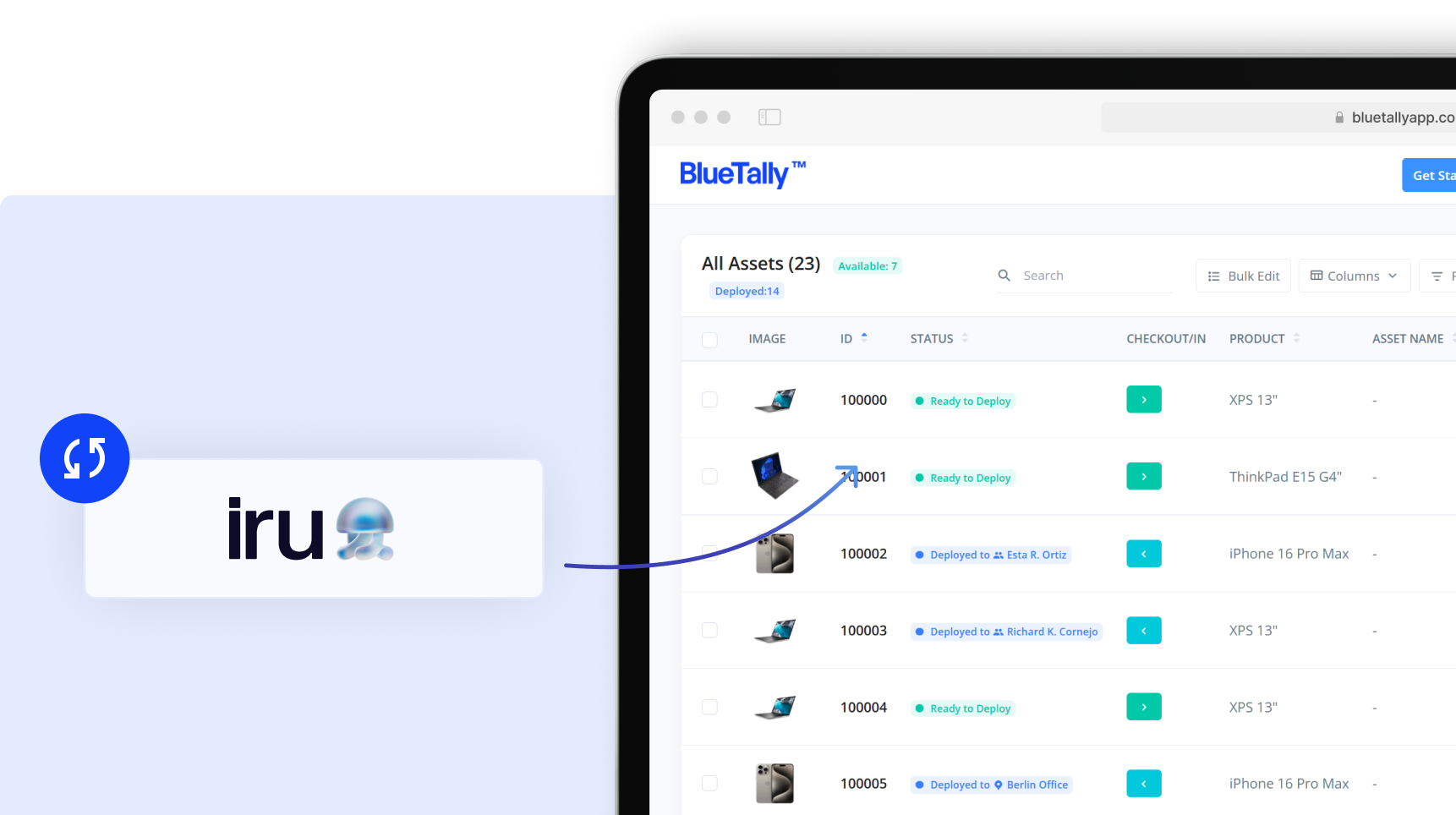
Automatically sync and manage Iru-enrolled devices with BlueTally - your complete Iru (formerly Kandji) asset management solution. BlueTally brings powerful IT asset management features to your Iru environment. With real-time syncing every 10 minutes, automated user assignments, and full lifecycle tracking, you get everything in one clean, unified platform.

What Is Iru Asset Management?
Iru asset management refers to tracking, managing, and assigning physical devices enrolled in Iru across your organization. With BlueTally, you gain real-time visibility into these assets - who’s using them, where they are, and what their lifecycle status is - without manual effort or spreadsheets.
Can Iru Be Used for IT Asset Management?
Only partially. Iru is a modern Apple device management (MDM) platform designed for deploying, configuring, and securing Mac, iPhone, iPad, and Apple TV devices. It excels at zero-touch deployment, automated patching, and compliance enforcement through Blueprints.
But Iru is an MDM, not an IT asset management solution. There's an important distinction.
Here's what Iru does well:
- Zero-touch deployment via Apple Business Manager integration
- Automated macOS and iOS patching with Auto Apps
- Blueprint-based configuration and compliance enforcement
- Device inventory with hardware and software details
- Security controls and endpoint detection
- Self Service app catalog for end users
Here's what Iru doesn't do:
- Track assets that aren't enrolled in Iru (monitors, docking stations, peripherals, Windows devices)
- Provide checkout and check-in workflows for equipment loans
- Track warranty expiration dates with proactive alerts
- Maintain assignment history showing who had the device and when
- Calculate depreciation or track purchase costs
- Support full lifecycle management from procurement to retirement
- Manage onboarding and offboarding asset workflows
Iru gives you excellent visibility into enrolled Apple devices and their compliance status. But for complete IT asset management - lifecycle tracking, financial data, assignment history, and inventory across all device types - you need a dedicated ITAM tool like BlueTally.
Limitations of Using Iru Alone for Asset Management
Relying on Iru as your only source of asset data creates gaps in your IT operations. Here's what you're missing:
1. Apple-only visibility
Iru only manages Apple devices. If you have Windows laptops, Chromebooks, Android devices, or any non-Apple hardware, Iru can't see them. Your asset inventory becomes fragmented across multiple systems.
2. No assignment history
Iru shows you who currently has a device, but not who had it before. When devices change hands, the previous assignment disappears. This creates problems during audits, investigations, or when tracking down missing equipment.
3. No lifecycle tracking beyond MDM
Iru knows a device is enrolled and compliant, but it doesn't track the full asset journey. When was it purchased? What did it cost? When does the warranty expire? When should it be refreshed? Iru doesn't answer these questions.
4. No checkout workflows
If you loan equipment, rotate shared devices, or manage a pool of loaner laptops, Iru offers no way to track check-out, check-in, or due dates. There's no accountability trail for temporary assignments.
5. No financial data
Purchase price, vendor information, PO numbers, depreciation schedules - none of this exists in Iru. Finance and procurement teams have no visibility into asset costs.
6. No support for peripherals
Monitors, docking stations, keyboards, mice, headsets - if it doesn't run macOS or iOS, Iru can't track it. These assets often represent significant investment but remain invisible.
7. Limited ITAM reporting
Iru's reporting focuses on compliance, security posture, and patch status. You can't easily answer questions like "how many MacBooks are out of warranty next quarter" or "which assets are unassigned."
These gaps are why IT teams pair Iru with a dedicated ITAM platform. BlueTally connects directly to Iru, imports your Apple devices automatically, and adds the lifecycle management features Iru lacks.
How BlueTally Enables Iru Asset Management
Sync all enrolled devices to BlueTally automatically
All Iru-managed devices are imported into BlueTally as assets - categorized by device type, named according to your preferences, and ready to track - without any manual input.
Link assets to employees
Devices are automatically checked out in BlueTally to employees based on Iru assignments, keeping ownership data accurate and up to date using email addresses from device user assignments.
Auto-update assignments based on device usage
When a device is reassigned in Iru, BlueTally reflects the change instantly - automatically checking in from the previous user and checking out to the new one without spreadsheets or manual syncing.
Trigger audit and lifecycle events based on Iru data
Use Iru data to automate audits, track compliance with Blueprint configurations, and manage device enrollment status over time - all synced every 10 minutes in one unified dashboard.
What Data Does BlueTally Sync from Iru?
BlueTally connects to your Iru instance and syncs device data every 10 minutes through a secure, read-only API connection. Here's exactly what gets imported:
Device identification:
- Serial number
- Device name
- Device ID
- Asset tag (if configured)
- Model and model identifier
Hardware details:
- Manufacturer (Apple)
- Device family (Mac, iPhone, iPad, Apple TV)
- Storage capacity
- macOS or iOS version
- Processor and memory
User assignment:
- Assigned user email
- User name (if available)
MDM and enrollment status:
- Blueprint assignment
- MDM enabled status
- Agent installed status
- Agent version
- Last check-in time
Automated Device Enrollment (ADE):
- ADE eligible status
- ADE profile assignment
BlueTally uses this data to automatically create asset records, assign devices to employees (matched by email), and keep everything synchronized. When a device is reassigned in Iru, BlueTally reflects the change automatically - checking in from the previous user and checking out to the new one.
You can also configure ADE mappings to automatically set default locations and statuses based on enrollment profiles, organizing new devices from the moment they appear.
The sync is one-way only. BlueTally reads from Iru but never writes back, so your Iru tenant remains completely untouched.
How to Use Iru + BlueTally
1. Connect BlueTally to Iru
Set up the integration in minutes following our Iru asset management setup guide and test your connection to ensure everything syncs seamlessly.
2. Configure your sync preferences
Map asset fields to Serial Numbers, Device Names, or Asset Tags, and configure Automated Device Enrollment (ADE) mappings to automatically set locations and statuses based on your Iru configurations.
3. Import your devices automatically
BlueTally automatically pulls in all your Iru devices - creating organized product categories, manufacturers, and individual asset entries ready for tracking and reporting.
4. Automatically assign devices
Assets are auto-assigned to employees in BlueTally based on Iru's assigned users using email address matching with no manual data entry required.
Why Choose Iru Over Jamf?
Iru and Jamf are both Apple-focused MDM platforms, but they take different approaches:
1. Iru advantages:
- Modern, intuitive interface designed for ease of use
- Auto Apps for automated third-party app patching
- Pre-built security controls and compliance templates
- Simpler Blueprint-based configuration
- Generally faster to deploy and manage
2. Jamf advantages:
- Longer track record and larger ecosystem
- Deeper scripting and customization options
- Stronger in education and highly regulated industries
- More extensive third-party integrations
Both are excellent Apple MDM solutions. But regardless of whether you choose Iru or Jamf, neither provides complete IT asset management. BlueTally integrates with both, giving you unified asset visibility across your entire Apple fleet - and any non-Apple devices you also manage.
Iru vs. Iru + BlueTally


BlueTally doesn't replace Iru - it extends it. You keep using Iru for MDM, Blueprints, patching, and compliance. BlueTally adds the asset lifecycle layer that Iru was never designed to provide.
FAQs About Iru Asset Management
Can Iru be used for physical asset management?
How does BlueTally pull data from Iru?
Can BlueTally check devices out to users automatically?
Is this integration secure?
Where can I find the full setup instructions for the Iru integration?
How does the Iru integration work in BlueTally?
What is Iru?
What's the difference between Iru and Jamf?
Can Iru track non-Apple devices?
Does Iru provide warranty tracking?
How does BlueTally handle Iru's Automated Device Enrollment (ADE)?
Can I use BlueTally with both Iru and Jamf?
How often does BlueTally sync with Iru?
Ready to simplify Iru asset management?
Skip the spreadsheets and manual tracking. Gain full control of your Iru assets — from ownership to lifecycle — all in a platform built for IT teams.
Try it free for 14 days
Try BlueTally free for 14 days — the IT asset management software trusted by top IT teams. No credit card required.


